Track your fitness & health online with these apps and websites

Whether you are just starting out with a new fitness routine, or if you’re a seasoned veteran fitness guru, it’s still difficult to navigate the endless amount of fitness apps for your phone and health websites online. However, one of my favorite fitness websites, Greatist.com, came out with an easy-to-read infographic with their recommendations for tracking your fitness online. Besides showing some of the top websites and apps it gives you reasons why it’s important to track your fitness online.

  • You’ll be more motivated.
  • It gives you more accountability.
  • You’ll benefit from planning.
  • Consistency.

Also, one website/app that didn’t make the list was endomondo.com. This website is a social network that allows you to track your workouts using a GPS tracking system in your phone or watch and share your results with the Endomondo community. You can create and accept challenges from other followers or just keep to yourself. Either way, it is a good way to track your progress as you continue your fitness routine.

(I think it goes without saying that Fit Girl Happy Girl is also one of the best fitness blogs out there!)
More Health and Fitness News & Tips at Greatist.

The argument for running naked

Scandalous, I know. But running naked may be the change you need to enhance your running routine. I’m not talking about ditching your shorts and t-shirt, but taking out the earbuds, leaving the phone at home and taking your eyes off of the television. Running without technology can help you get in touch with yourself as a runner and teach you to focus solely on your run.

Since I started my running routine, I always wore headphones and listened to music. Mostly because I was using an app on my phone to train but also because I thought I’d get bored just running with nothing else to do. The other day I forgot my headphones when I went to the gym. I wasn’t going to not run because of this so I ran naked (without tech). I felt that I had a much easier time focusing on my breathing and pace and was actually able to PR. I couldn’t believe what a difference it made in my stride!

A recent article in Runner’s World quoted Ben Agger, Ph.D., director of the University of Texas at Arlington Center for Theory, saying, “Wearing technology while running intrudes on the mind’s attempt to give itself over to the body.”

In essence, constantly checking your watch to monitor your pace, distance and calorie count actually takes away from your run rather than improve it. Being focused on the numbers means you’re losing focus of the actual run. Also, we all have a set number in our mind, whether it be a PR time or distance, and focusing too much on that can actually limit you in your ability to get to that goal. Numbers can be motivational but they can also put a lot of stress on your runs.

When it comes down to it, it’s all about personal preference. I asked some of my fellow members of the sub-30 Club on Facebook and the responses were about 50/50. Some people said they like to run with tech so they can know if they are improving in their training. Others said they switch it up and run with tech indoors and without tech outdoors. But a slightly larger portion of the responders said they enjoy running naked because they can get in tune with their running body.

For me, I enjoyed running naked. I was able to focus on my pace, form, breathing and what my body was telling me, instead of what the numbers read on my phone. Running is supposed to be fun, so savior the experience!

Reach your running goal? Learn how to add more miles

Today was an exciting day because for the first time since starting the Couch to 5K program in March, I reached 3.1 miles without taking a break or feeling like I was going to keel over and die. I got to the 3.1 mark at 33:33, and that included a 5 minute warm-up walk. I’m hoping that as I continue my running routine I can shave off some time by cutting down on the warm-up, in order to run a sub-30.

For the rest of you who may have reached your running goal and want to push further to build endurance,  Jeff Galloway, from Runner’s World, wrote up a simple training plan to help you double your endurance in only six weeks.

First off, the article says you should shoot for running three times a week. Right now I run three days a week with crossfit (cardio kickboxing, strength training, target training etc.) in between. However, it is important to let your muscles rest before and after running because then they’ll be fresher for your next run.

The article also suggests designating each day for a different kind of run. One day can be for a “maintenance” run, a run that maintains your fitness and is easy-going. Another day can be for a long distance run, this is the day you’ll begin to increase your mileage. The third day can be set aside for speed play, or “fartlek” (funny word, I know). On a speed play you want to start running at a normal pace and pick up your speed when you’re ready. The article says you can focus on an object and sprint towards it then job for recovery.

As always, remember to pace yourself and stay hydrated. You don’t want to lose all of your energy at the start of your run at the risk of becoming exhausted, so start slow in the beginning and pick up the pace as each miles passes.

Here is the training plan designed by Runner’s World to build mileage in six weeks:

Week ONE:
Maintenance (Miles) – 3.5
Fartlek (Miles) – 3
Long Run (Miles) – 4

Week TWO:
Maintenance (Miles) – 4
Fartlek (Miles) – 3.25
Long Run (Miles) – 5

Week THREE:
Maintenance (Miles) – 4
Fartlek (Miles) – 3
Long Run (Miles) – 4

Week FOUR:
Maintenance (Miles) – 5
Fartlek (Miles) – 3.5
Long Run (Miles) – 6

Week FIVE:
Maintenance (Miles) – 5.5
Fartlek (Miles) – 3
Long Run (Miles) – 4

Week SIX:
Maintenance (Miles) – 6
Fartlek (Miles) – 3.5
Long Run (Miles) – 7

Anatomy of a good pair of running socks

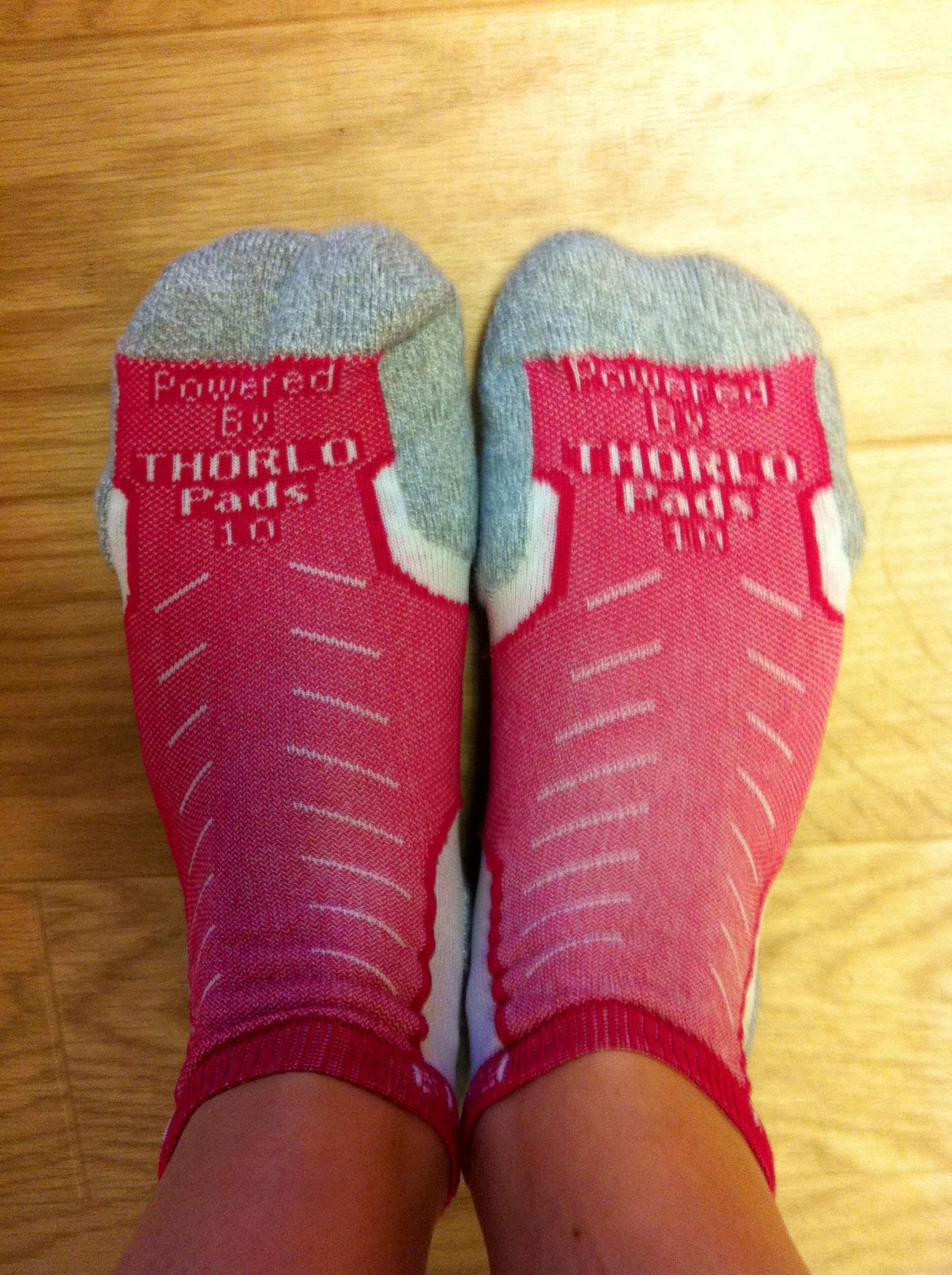
Do not underestimate the power of a good pair of running socks, they will change the outcome of your run, I can guarantee it. My dad used to be a marathoner and he told me that my mom would meet him at 13.1 miles in just so he could change his socks. Yeah, they’re that important.

I just invested in a new pair of running socks, totaling $12.00 for one pair, but it was so worth it. Whether you’re running a marathon, a 5k or just going for a jog, the cushioning provided by a good pair of running socks will help you to sustain the run. A good pair of socks should be lightweight, cushioned and able to absorb moisture.

Livestrong.com says “The ideal socks for running a marathon will tolerate miles of pounding during training and complement your running shoes ability to provide stability. Livestrong gives three criteria that must be met in looking for a new pair of running socks- material, cushioning and stitching.

  • Material- You want to look for a running sock made out of material that will draw moisture away from your feet and that will be able to withstand the rigors of training and multiple washes. Cotton socks tend to give blisters because cotton absorbs sweat and chafes easily against skin. It’s best to chose a sock made out of synthetic material like polyester and spandex because they are designed to pull moisture away from the foot. Not all natural fibers are bad however. Material such as bamboo can have natural tendencies to pull moisture away.
  • Cushioning- Cushioning in socks is extremely important because it can help stabilize the foot while running. When choosing a sock for running the cushioning depends on your foot type. If you have a high arch you may want to opt for a sock with more cushioning in the center to provide stability. Other socks offer cushioning in the heel and ball of your foot to combat pronation and again to stabilize the foot. It’s best to consult with a speciality running store to determine your foot type and the sock most appropriate for you.
  • Stitching- When running for prolonged amounts of time, it’s important to avoid chafing and irritation that may result in blisters. According to Livestrong “Hand-linked or seamless toe enclosures help prevent chafing at the top of the toes. Look for socks featuring “Y” and “W” stitched heel gores which further improve the socks fit.” This will help prevent the sock from slipping down while running.

Are you guilty of treadmill racing?

(via Pinterest)

As a new runner, I’m certainly not one who should be openly admitting this but, I will admit that I usually glance down at the speed of the runner next to me on the treadmill. It’s called treadmill racing. It’s petty and I don’t really gain anything from it, but what can I say? I’m competitive.

Since I have been training for my first 5k, I’ve been doing most of my runs on the treadmill because the program calls for a lot of interval training and I find it easier to monitor my time on the treadmill. But I’ve noticed a trend at my gym among the runners to my left and right. Occasionally, my co-runners will glance down at the speed I’m running, and in turn I tend to do the same thing. It’s mostly out of curiosity but I think this bad habit can cause some people to become uncomfortable. For me, when someone next to me is running faster, instead of feeling bad about not going as fast, I use it as motivation for future runs.

However, I also know that some gym-goers can be uber-competitive, making you feel self-conscience of your running. But, keep in mind, you don’t know what they are training for, whether it be sprints or distance, and they don’t know what you’re training for, so be confident in your running!

Women’s Health Magazine suggests setting the time you want to run and then covering the display with a towel to ward off any wandering eyes. Don’t worry about your neighbor’s speed because it’ll distract you from your own run. If treadmill racing is too stressful, opt for an outdoor run, free of competition and numbers. Outside you are running your own speed, and no one can one-up you on that.

Morning workouts to boost your energy

Rise and get fit! (via Pinterest)

There’s a common misconception that to be a morning workout person you have to be a morning person. False. It helps if you like the morning but it’s not a requirement. I started doing early morning workouts in the fall when I took a job requiring me to start work at 6:00 a.m. I’ve always been an early riser but having enough energy to exercise before the sun is up wasn’t really in my schedule.

However, now that I’ve started working out in the morning I’ve found there are so many benefits that outweigh the temptation of hitting the snooze button. First off, if you work out in the morning you can be reassured to get in your sweat for the day.

“If you work out be­fore your day distracts you, your chances of exercising regularly go way up,” said Cedric Bryant, Ph.D., chief science officer of the American Council on Exercise, in an article in Women’s Health Magazine. People who work out in the morning have a higher chance of making a habit of an exercise routine. Also, working out in the morning is sure to keep you sharper during the day because exercise enhances secretion of neurotransmitters.

Another benefit of an early-bird workout is that exercise at the start of your day can boost your metabolism for the rest of the day, allowing you to more effectively burn calories.

There are definitely days that I’d rather hit the snooze button and go back under my covers but working out in the morning makes me feel like I’ve already accomplished something that day. But like any new routine, you can ease into it and acclimate to the new routine with these tips:

  • Make it a date- You wouldn’t blow off a date on any other occasion so why leave your fitness plan hanging? Make your morning workout into the dream guy or girl of dreams who you’d never stand up.
  • Mangia!- Eat something! You’ve been asleep for the last eight to 10 hours so you don’t have any calories to burn. Whatever you choose to eat make sure it contains some carbs. I usually have a small bowl of cereal or granola bar (and some coffee so I don’t fall asleep on my drive to the gym!).
  • Get you gear in gear- Having your gear ready the night before so you’ll be set to head out early. The more time you waste looking for your water bottle and socks, the more time you have to come up with an excuse not to go. I keep my gym bag next to my nightstand to remind me to get out of bed, my gear is waiting.
  • Take a class- Sometimes the best way to ease into a morning workout routine is by taking a class that’s filled with other people who are just as tired as you are. The group dynamic will keep you motivated to keep going.
  • Give it time- It won’t be easy in the first week or so to get into the grove of working out early. You might experience a crash around late afternoon- according to Active.com “morning exercisers often need to eat more in the morning and less in the evening to optimize their performance all day.”

Once you get into your new routine, I promise you will feel more energized and motivated to take on the rest of your busy day!

Hunger Games workout: Train like a Tribute

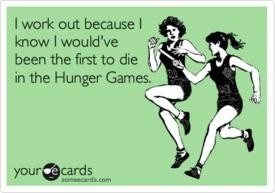
"I work out because I know I would've been the first to die in the Hunger Games." (via Pinterest)

The much anticipated adaptation of Suzanne Collins’ hit novel “Hunger Games” was released today and fans are wondering how they can get in shape like star heroine Katniss Everdeen. One New York gym has developed a new workout, Train Like a Tribute, to get fans and fitness lovers alike in shape for the Hunger Games arena.

New York Sports Club fitness instructor and former Marine, Eric Salvador, created a workout similar to the training of the “tributes” in the book. He developed exercises that simulate the four skills necessary for survival in the “Hunger Games”- archery, tree climbing, speed work and strength. Although the classes do not start until next week, classes will also be offered in Boston, Philadelphia and Washington D.C.

Salvador’s 45-minute workout includes “Katniss kickbacks and Peeta presses (named for two of the main characters), along with archery work, simulated tree climbing (using TRX bands) and even a ‘Sprint to the Cornucopia,'” according to a TODAY Health article.

“In the book, the characters have to sprint at the beginning to grab all the materials they need for survival,” Salvador said in the article. “In our class, the participants sprint to the center of the room to grab their dumb bells, water, mat, towel and a bow. But they can only grab one item at a time, so they’re going back and forth and back and forth.”

Fox News gave an outline of some of the exercises that are involved in the workout:

  • Katniss Killers- Using an actual bow, ” while standing in an archer’s stance, participants pull the bow back until taut.  But instead of releasing the bow string, they bring their arms back to starting position and repeat until finished.”
  • Capitol Crunches- “The capitol crunches help participants improve their core strength.  Tributes lay flat on their backs, with a weight extend above their heads.  They are then told to do a number of full sit-ups while keeping the weight above their heads.”
  • Jabberjay Jacks-  “In the ‘Train Like a Tribute’ workout, jabberjays are also keeping tributes in line by making them do jumping jacks while crossing their legs.  This helps them improve their speed and agility for the games.”
  • Peeta Presses- “In order to build strength, participants position dumbbells by their shoulders and then extend them upwards over their heads.”

Stretches to combat runner’s knee, one of the most common running injuries

One of the most common over-use injuries for runners is Patellofemoral Pain Syndrome, or more commonly known as runner’s knee. This injury occurs “when a mistracking kneecap (patella) irritates the femoral groove in which it rests on the thighbone (femur),” according to Runner’s World. It’s extremely hard to pinpoint the exact cause of this overuse injury because there are so many possibilities. Runner’s World gives the following as possible causes for runner’s knee:

  • The patella may be larger on the outside than it is on the inside, it may sit too high in the femoral groove, or it may dislocate easily.
  • Worn cartilage in the knee joint reduces shock absorption, high-arched feet provide less cushioning, and flat feet or knees that turn in or out excessively can pull the patella sideways.
  • Tight hamstring and calf muscles put pressure on the knee, and weak quadriceps muscles can cause the patella to track out of alignment.
  • Constant overuse alone can also stimulate soreness.

Women are more likely than men to develop runner’s knee because they have wider hips, putting the kneecap under more stress. Runner’s knee also affects mostly younger, recreational (non-professional) runners.

I have recently developed runner’s knee, only a month and a half into my 5k training, but I’m looking at some options to relieve the stress from my knee. For me I’m pretty sure the cause is from overuse because I exercise six out of the seven days in a week. To combat my runner’s knee I’ve read that there are specific stretches targeted at relieving stress from the kneecap. One of the most important stretches is for the iliotibial band, this is the tendon that runs from the hips down the outside of your thigh and tucks in just below the knee.

Below is a pretty good video outlining some stretching exercises to heal your runner’s knee.

A beginners guide to training for a 5k

Never in my life would I have considered myself to be a “runner.” I only ran in high school for sports practice and rarely ran other than that. When I started my 5k training I was in relatively good shape already- doing kickboxing three or four times a week, with regular weight and cardio days in between. However, for some reason I always wanted to run a road race. My dad was a marathoner back in his heyday, he ran a total of 16 marathons (including eight Boston Marathons) among other smaller races. This had to be a good sign for me then, running ran in my blood.

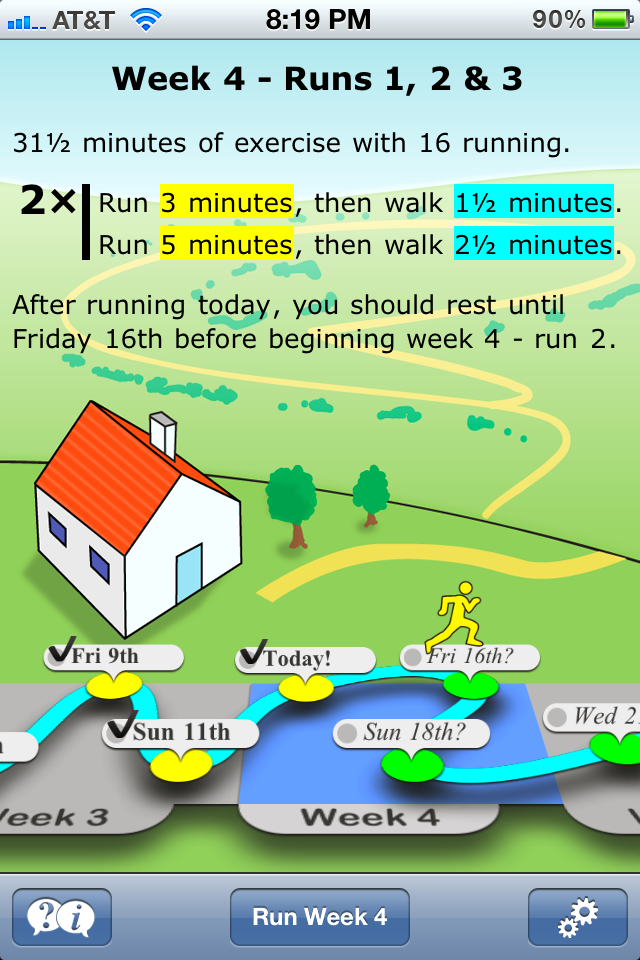
I had heard of these “couch to 5k” programs and thought maybe that would be a good place to start. Since we live in a Mac world, I immediately sought the assistance of my iPhone to find an app that would help me get started. There are tons of “couch to 5k” apps in the app store but I settled on the “Get Running” app because the reviews seemed good. The app works especially well when you plug in your headphones- a woman’s voice will guide you through the run and tell you when it’s time to walk and when to cool down and stretch. I am on week 4 and so far so good!

Screen shot of the "Get Running" app.

The problem most beginner runners have is that they start off too fast and too strong and get winded very quickly. The goal of the “couch to 5k” program is to ease beginners into running by doing a series of interval training, mixing running and walking, with rest days in between. A lot of beginners become overly ambitious and focused on the mileage they run but it’s really better to take it slow at first and build up endurance to get to your goal.

Since I started running I have become obsessed, I guess that’s what you would call a “runner’s high.” I have registered for a 5k for June 3rd in Hampton, N.H. and am hoping to reach a goal of under 30 minutes. I think it’ll be doable but only time will tell. I will keep you updated as I continue with my training. Happy running!