
We all know that stretching after a run is extremely important. But if you’re sick of your post-run stretch routine, you may want to try out some of these yoga positions. Runner’s World posted a video with a few key yoga positions for runners to try out after a run.
Are you guilty of treadmill racing?

(via Pinterest)
As a new runner, I’m certainly not one who should be openly admitting this but, I will admit that I usually glance down at the speed of the runner next to me on the treadmill. It’s called treadmill racing. It’s petty and I don’t really gain anything from it, but what can I say? I’m competitive.
Since I have been training for my first 5k, I’ve been doing most of my runs on the treadmill because the program calls for a lot of interval training and I find it easier to monitor my time on the treadmill. But I’ve noticed a trend at my gym among the runners to my left and right. Occasionally, my co-runners will glance down at the speed I’m running, and in turn I tend to do the same thing. It’s mostly out of curiosity but I think this bad habit can cause some people to become uncomfortable. For me, when someone next to me is running faster, instead of feeling bad about not going as fast, I use it as motivation for future runs.
However, I also know that some gym-goers can be uber-competitive, making you feel self-conscience of your running. But, keep in mind, you don’t know what they are training for, whether it be sprints or distance, and they don’t know what you’re training for, so be confident in your running!
Women’s Health Magazine suggests setting the time you want to run and then covering the display with a towel to ward off any wandering eyes. Don’t worry about your neighbor’s speed because it’ll distract you from your own run. If treadmill racing is too stressful, opt for an outdoor run, free of competition and numbers. Outside you are running your own speed, and no one can one-up you on that.
Zumba fitness frenzy shows Latino influence on U.S. culture
I wrote this story for one of my classes in which the students in the class are contributers to the online news organization, La Prensa.
Zumba has been hitting the fitness community by storm and is starting to raise questions of whether this is just a new fitness trend, or whether the spike in interest in the Latin-music inspired cardio class is a depiction on the greater Latino influence on the cultural landscape of the United States.
“I definitely think it is something positive for the [Latino]/Latin American community, and I feel through attending a Zumba fitness class they will feel more welcoming, more accepting to Latin American culture,” said Gabby Corbera, a junior at the University of Massachusetts Amherst and Zumba instructor at the university’s Recreation Center. “It’s really important because in 2050 they [Latinos] are going to be the majority.”
Zumba was first created by accident by choreographer and fitness instructor, Alberto “Beto” Perez, in Cali, Colombia. In 1986, Perez forgot his aerobics tapes for a class he was teaching in Cali so he used the tapes he had in his bag that were recordings of traditional Caribbean salsa and merengue music, and improvised a routine. Using this “supposedly” non-traditional music for an aerobics class ended up being a hit and in 2001, after moving to the United States, Perez partnered with Alberto Perlman and Alberto Aghion to create a demo video. Now Zumba classes can be found in over 110,000 gyms and in 250 countries.
Corbera, who was born in Venezuela to Peruvian parents, said that the widespread practice of Zumba classes worldwide shows just how important Latin American/Caribbean culture is not only in the United States but also across the globe.
“I really love that people can get a sense of it, a taste of it just by going to one hour of Zumba fitness class,” she said. “It’s not limited to a Latin American narrative, it incorporates a lot of different beats from Asia and other parts of the world.”
Corbera was the first Zumba instruct at UMass’ Recreational Center and said that she began taking Zumba classes when she was in high school. Corbera said she is most attracted to the music in Zumba classes and the energy that all of the attendees have in the class. While Zumba is influenced by traditional Latin American/Caribbean dances, it is not limited to them. Some dances included are cumbia, salsa, merengue, mambo, flamenco, chachacha, reggaeton, soca, samba, belly dancing, bhangra, hip-hop and tango.
“I try to bring in an international perspective to the class by trying to incorporate international beats and international rhythms; that is what the program was founded on,” she said.
“What I’ve noticed in my classes, because of the music I play, because it’s not just hip hop, because it’s not just American pop music it attracts different types of groups here on campus. In terms of demographics I’d have to say it’s very diverse- Latinas, Asians, African-Americans – just anyone and it’s because of the music I feel,” she continued.
Zumba’s pervasive cross-cultural popularity ranked it ninth on CNN Health’s top fitness trends for 2012. Besides it’s cultural impact, Zumba helps fitness goers burn 600 to 1,000 calories in a single one-hour session.
“Part of what I love about Zumba is it allows me to embrace my ethnic identity and that’s really important for me,” Corbera said.
As Zumba and other Latino-influenced cardio classes continue to find their place in gyms across the country, Corbera encourages people of all cultures to “Come, work out and get a little cultured.”
Manifesto: Stay Healthy and Fit
 More must-read health & fitness news and information at Greatist.
Kickboxing: Learn to Hit Like a Girl

Destroy what destroys you. Kick it! (via Pinterest)
Over the past few years women’s interest in kickboxing has been steadily increasing and they are getting hooked on the one-two punch of the high intensity cross-fit cardio workout. The decision to debut women’s boxing in the 2012 Olympics this summer also reflects the growing interest in the sport, leading more and more gyms to host cardio kickboxing classes.
Cardio kickboxing classes are typically one-hour long and provide a dynamic exercise that includes both cardio and resistance training. If you’re a runner this workout is ideal to not only improve your stamina and endurance but to build long, sleek muscles that will help you feel stronger during your run and push your hardest come race day.
Kickboxing provides you with a complete, all-over body workout. Because it doesn’t just target specific areas, it allows you to strengthen, tone and reduce fat all over at the same time. It also helps to increase flexibility and especially reflexes.
Self-defense is another added benefit of taking a cardio kickboxing class. During an average kickboxing class, the instructor teaches you different kicks (round-house, side kick, back kick, etc.), punches (jabs, hooks, uppers, ribs, etc.) and how to learn to keep your guard up and to bob and weave. While not all cardio kickboxing classes use punching bags, the instructor will help you learn how to gauge the distance of your target and how to through a proper punch, all while remembering to keep your guard up and protect yourself.
Not only does kickboxing give you a serious workout (burning on average of 1,000 calories in a single one-hour session) it also is a good way to relieve stress. The instructor always reminds you to think of your target, whether that be a person or a thing that is causing stress in your life- letting out your aggression in a class is much better than actually letting it out on the person or thing. According to the American Fitness Professionals Association, “Stress, however, produces enzymes that reduce your supply of endorphines. If you don’t exercise to stimulate that supply of endorphines, you will consequently not feel as well as you could.”
More than anything, kickboxing also helps you to build confidence and self-esteem. For me, taking kickboxing classes is a stress reliever and it helps me to know that I can take care of myself and nothing is too hard to overcome. When I walked into my first kickboxing class I didn’t know if I was going to be able to make it out alive! But as I continued to take class (I now go three or four times a week) my endurance started to build and I realized that I was strong enough to make it through the class. And for some reason, the reaction I get from people when I tell them I do kickboxing is too good to ever give up, so keep your guard up and learn to hit like a girl!
Why you should start running

via Pinterest
As I’ve said before, I was never really a runner, but every day that passes while I continue my running routine I am started to love it more and more. I’ve started to look forward to running each day and miss it on my days off. Here are some of the top reasons you should start this amazing confidence-boosting, calorie-burning, envigorating exercise.
- You can run anywhere and everywhere because there is no equipment necessary.
- No gym necessary so you can save some cash.
- The running community is open and inviting so it’s a great opportunity to meet new people.
- You might live longer because runners have fewer disabilities, remain active longer than their less active counterparts.
- Although I don’t think people should exercise with the sole focus of burning calories, they should exercise to become fit and healthy, running is one of the top calorie-burning exercises.
- Running helps to boost your metabolism after you’ve finished.
- You can change up the scenery of your fitness routine- indoors, outdoors, on a treadmill, on a trail, on the beach, wherever!
- It’s a mood booster.
- Running solo can help you to focus on your life and maybe even have a moment of self discovery.
- It reduces stress, fights depression and anxiety, and can even boost your creativity.
- Running can even invigorate your sex life!
- Most importantly, running can give you goals to work towards.
There are so many other benefits of running but besides all of the natural health benefits I see running as your “you” time. It’s a time for you to clear your head and do something healthy for yourself. I find that running is a great time to do some thinking, brainstorming or reflection about my day and what’s going on in my life. Also, for me running started out as a goal and as I continue to reach the goals I set each week my goals keep getting bigger.
Morning workouts to boost your energy
Rise and get fit! (via Pinterest)
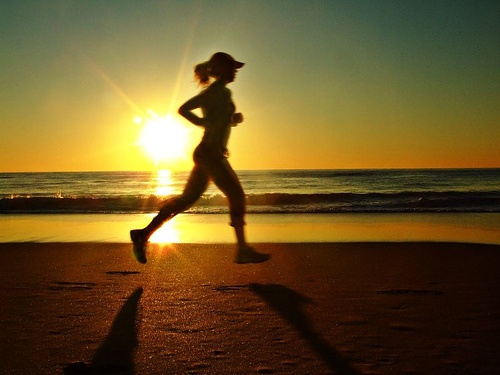
There’s a common misconception that to be a morning workout person you have to be a morning person. False. It helps if you like the morning but it’s not a requirement. I started doing early morning workouts in the fall when I took a job requiring me to start work at 6:00 a.m. I’ve always been an early riser but having enough energy to exercise before the sun is up wasn’t really in my schedule.
However, now that I’ve started working out in the morning I’ve found there are so many benefits that outweigh the temptation of hitting the snooze button. First off, if you work out in the morning you can be reassured to get in your sweat for the day.
“If you work out before your day distracts you, your chances of exercising regularly go way up,” said Cedric Bryant, Ph.D., chief science officer of the American Council on Exercise, in an article in Women’s Health Magazine. People who work out in the morning have a higher chance of making a habit of an exercise routine. Also, working out in the morning is sure to keep you sharper during the day because exercise enhances secretion of neurotransmitters.
Another benefit of an early-bird workout is that exercise at the start of your day can boost your metabolism for the rest of the day, allowing you to more effectively burn calories.
There are definitely days that I’d rather hit the snooze button and go back under my covers but working out in the morning makes me feel like I’ve already accomplished something that day. But like any new routine, you can ease into it and acclimate to the new routine with these tips:
- Make it a date- You wouldn’t blow off a date on any other occasion so why leave your fitness plan hanging? Make your morning workout into the dream guy or girl of dreams who you’d never stand up.
- Mangia!- Eat something! You’ve been asleep for the last eight to 10 hours so you don’t have any calories to burn. Whatever you choose to eat make sure it contains some carbs. I usually have a small bowl of cereal or granola bar (and some coffee so I don’t fall asleep on my drive to the gym!).
- Get you gear in gear- Having your gear ready the night before so you’ll be set to head out early. The more time you waste looking for your water bottle and socks, the more time you have to come up with an excuse not to go. I keep my gym bag next to my nightstand to remind me to get out of bed, my gear is waiting.
- Take a class- Sometimes the best way to ease into a morning workout routine is by taking a class that’s filled with other people who are just as tired as you are. The group dynamic will keep you motivated to keep going.
- Give it time- It won’t be easy in the first week or so to get into the grove of working out early. You might experience a crash around late afternoon- according to Active.com “morning exercisers often need to eat more in the morning and less in the evening to optimize their performance all day.”
Once you get into your new routine, I promise you will feel more energized and motivated to take on the rest of your busy day!
The ‘Greatist’ Runner’s Guide
I came across this infographic on one of my favorite fitness blogs, Greatist.com, and thought I’d share it. It’s a clear, concise and visually appealing runner’s guide, that gives you all the information you need about running, from finding the right shoe for your running type to eating the right foods to enhance your performance.

More Health and Fitness News & Tips at Greatist.
The makings of a “runner”
(via Pinterest)
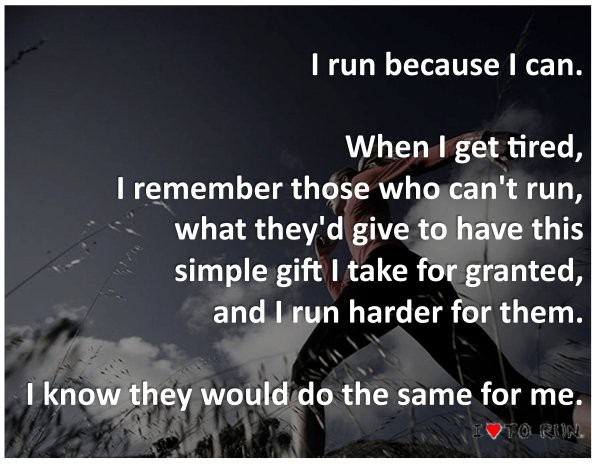
“Congratulations! You can now call yourself a runner!” Betty told me as I finished my run today, sending me into the final third of my 5k training program. Betty is the British woman who narrates my running workouts on the “Get Running” app I downloaded two months ago. I felt pretty good after she reassured me that I was actually a runner, but why now? Why wasn’t I already a runner? What makes a runner, a “runner”?
Granted I’ve only been really running consistently for the past two months. I ran in high school when I had to for varsity sports but I never ran for fun. Now that I’ve gotten back into running all I want to do is become really good at it but I know I have a ways to go. What I’ve come to realize however is there are so many different categories of runners- there are marathoners, sprinters, trail runners, distance runners, triathletes, joggers, beginners, professionals, recreational runners, and so many more. While these categories separate runners, they don’t mean that one category is better than the other.
In an article on Active.com, freelancer, Anne Kymalainen, writes, “To me, the true definition of a runner is not necessarily only that person with the thin legs and the short shorts running the sub-six-minute miles but a person who honestly feels a pull of sneakers to the road or trail.”
I cannot agree more. There is such an emphasis sometimes on speed and distance in running- runners who can run a sub-six-minute mile are “real” runners- but I think a “real” runner is anyone who can get out on the open road, pace themselves, be confident in their stride and feel good about the miles they ran, no matter how long it takes them.
Murphy’s Law of Running
I found this image on Pinterest, posted by the running blog, the RUNiverse, and I had to share it with you guys- it’s Murphy’s law for runners.

Murphy's Law of Running
 Fit Girl. Happy Girl.