
I have a great update! Since buying my new Asics GT-2170s my runner’s knee has almost healed 100 percent. I’ve been continuing with the stretches I posted before as well as actually resting on my “rest days” and I think it has paid off. I’ve also continued using the compression strap which I would highly recommend to anyone else who is having problems with runner’s knee. The stretch that I have found most helpful is the Illiotibial Band stretch. Here are some other after-run stretches:
Category Archives: Running
Fun races for any runner
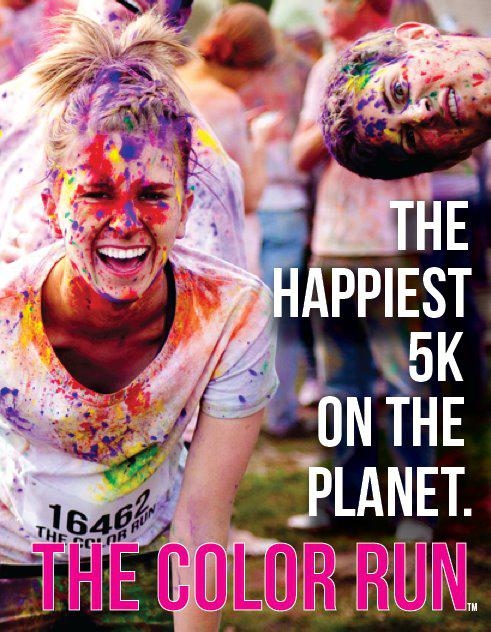
The Color Run
Who says running has to always be so serious? Personally, I like to switch up my running routine by running at the gym, around my town, on the beach and on trails, and there are plenty of races out there to accommodate all running styles. Whether you are looking for a scenic race, a fast race, a dirty race or just a crazy race, websites like Active.com and CoolRunning.com are great resources to help you find the perfect race. Here are some of my favorites:
- The Color Run– This 5k race takes place all over the country and is “3.1 miles of color madness.” The Color Run is for runners of all experience levels and ages and is designed to be more about fun than about speed. Every runner is required to wear a white t-shirt and as they approach each mile marker, color paint is blasted onto them- by the end of the race “they end looking like they fell into a Willy Wonka… tie dyed… vat of colored goodness.”
- Hollis Fast 5k– If you’re looking to get your best 5k time, you may want to sign up for this race because it is the fastest 5k in New Hampshire. The race is a USATF-certified point-to-point downhill course creating a unique run for all participants. Some of the fastest 5k times have been recorded at this race as the course drops 224 feet in elevation in the 3.1 miles. Unfortunately, this drop in elevation exceeds the state limitations to qualify times for state records, but that doesn’t have to stop you from getting your own PR!
- Will Run for Beer race series– This race series takes place throughout New Hampshire and Massachusetts and is sponsored in part by Smuttynose Brewing Company. I am running my first 5k in one of the series races in Hampton, New Hampshire and the best part of this 5k is there is free beer at the end. (No other incentive necessary!)
- Rugged Maniac 5k– You thought the Color Run looked messy? Try the Rugged Maniac 5k, a 3.1 mile obstacle race. Each course has at least 20 obstacles that include climbing over 7-foot walls, crawling through mud, jumping over fire and more. This is for the true adventure-seeker who is sick of your average 5k and is willing to get a little rugged!
- Luv2Run Portland– If you’re just looking for a scenic 5k to run, the Luv2Run Portland might be the right race for you. The off-road course through the Back Cove Trail in Portland is a scenic race sure to please any running who enjoys running near the ocean.
What a difference a sneaker can make

My new Asics GT-2170 sneakers!
I’m home on Spring Break right now so I thought I’d take advantage of my time off to update some of my running gear. First on my list was new sneakers. As I’ve mentioned in previous posts, I’ve been having trouble with runner’s knee, and I have read in a few articles online that being fitted for the right sneakers is extremely important. Apparently, I was running on the complete wrong type of sneakers for my biomechanics. After getting some help from the lovely people at Marathon Sports, a specialty running store in the Boston area, that actually specializes in a unique fitting process called “The Right Fit.” Trained staff at Marathon Sports give a personal consultation to each customer to help them find the perfect shoe for their running routine. The right sneaker can mean the difference between staying active and getting injured.
Before you go on a search for your perfect running shoe, there are some key words you may want to familiarize yourself with:
- Overpronation: runner’s whose foot rolls inward. According to Runner’s World, “This means the foot and ankle have problems stabilizing the body, and shock isn’t absorbed as efficiently.”
- Underpronation: conversely, this is when the runner’s foot rolls outward. Runner’s World says that the “forces of impact are concentrated on a smaller area of the foot (the outside part), and are not distributed as efficiently.”
- Normal pronation: this is the ideal pronation because the foot optimally distributes the forces of impact. RW says, “the foot ‘rolls’ inward about fifteen percent, comes in complete contact with the ground, and can support your body weight without any problem.”
Women’s Health has a pretty comprehensive sneaker guide to help you get started with your search. My best suggestion would be to go to a local specialty running store where people who really know what they’re talking about can help you. It worked for me and there was a huge improvement after I tested out my new sneakers. Also, there’s nothing better than a new sneaker to get you motivated with your running routine!
Stretches to combat runner’s knee, one of the most common running injuries
One of the most common over-use injuries for runners is Patellofemoral Pain Syndrome, or more commonly known as runner’s knee. This injury occurs “when a mistracking kneecap (patella) irritates the femoral groove in which it rests on the thighbone (femur),” according to Runner’s World. It’s extremely hard to pinpoint the exact cause of this overuse injury because there are so many possibilities. Runner’s World gives the following as possible causes for runner’s knee:
- The patella may be larger on the outside than it is on the inside, it may sit too high in the femoral groove, or it may dislocate easily.
- Worn cartilage in the knee joint reduces shock absorption, high-arched feet provide less cushioning, and flat feet or knees that turn in or out excessively can pull the patella sideways.
- Tight hamstring and calf muscles put pressure on the knee, and weak quadriceps muscles can cause the patella to track out of alignment.
- Constant overuse alone can also stimulate soreness.
Women are more likely than men to develop runner’s knee because they have wider hips, putting the kneecap under more stress. Runner’s knee also affects mostly younger, recreational (non-professional) runners.
I have recently developed runner’s knee, only a month and a half into my 5k training, but I’m looking at some options to relieve the stress from my knee. For me I’m pretty sure the cause is from overuse because I exercise six out of the seven days in a week. To combat my runner’s knee I’ve read that there are specific stretches targeted at relieving stress from the kneecap. One of the most important stretches is for the iliotibial band, this is the tendon that runs from the hips down the outside of your thigh and tucks in just below the knee.
Below is a pretty good video outlining some stretching exercises to heal your runner’s knee.
A beginners guide to training for a 5k
Never in my life would I have considered myself to be a “runner.” I only ran in high school for sports practice and rarely ran other than that. When I started my 5k training I was in relatively good shape already- doing kickboxing three or four times a week, with regular weight and cardio days in between. However, for some reason I always wanted to run a road race. My dad was a marathoner back in his heyday, he ran a total of 16 marathons (including eight Boston Marathons) among other smaller races. This had to be a good sign for me then, running ran in my blood.
I had heard of these “couch to 5k” programs and thought maybe that would be a good place to start. Since we live in a Mac world, I immediately sought the assistance of my iPhone to find an app that would help me get started. There are tons of “couch to 5k” apps in the app store but I settled on the “Get Running” app because the reviews seemed good. The app works especially well when you plug in your headphones- a woman’s voice will guide you through the run and tell you when it’s time to walk and when to cool down and stretch. I am on week 4 and so far so good!
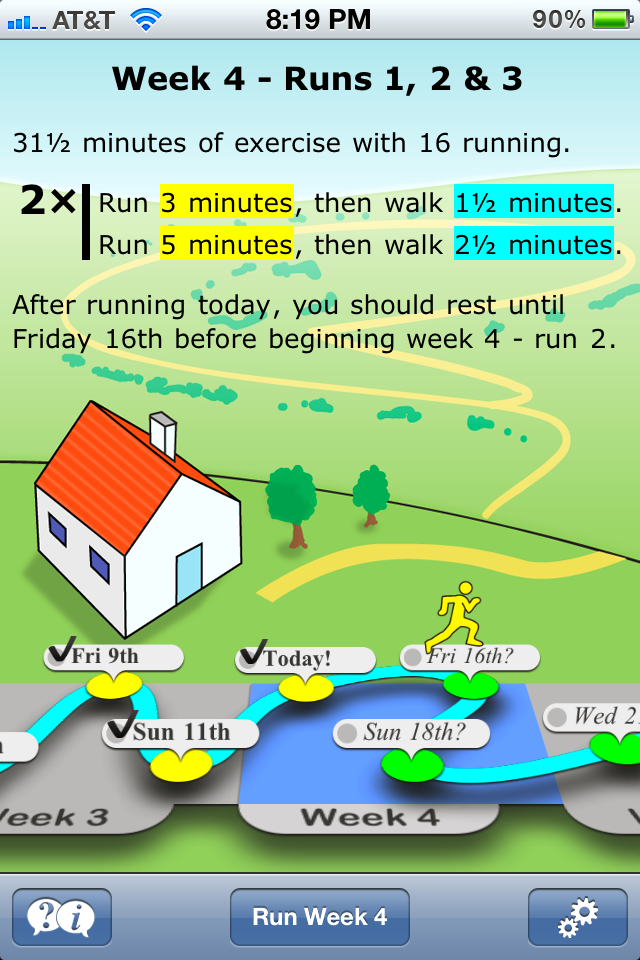
Screen shot of the "Get Running" app.
The problem most beginner runners have is that they start off too fast and too strong and get winded very quickly. The goal of the “couch to 5k” program is to ease beginners into running by doing a series of interval training, mixing running and walking, with rest days in between. A lot of beginners become overly ambitious and focused on the mileage they run but it’s really better to take it slow at first and build up endurance to get to your goal.
Since I started running I have become obsessed, I guess that’s what you would call a “runner’s high.” I have registered for a 5k for June 3rd in Hampton, N.H. and am hoping to reach a goal of under 30 minutes. I think it’ll be doable but only time will tell. I will keep you updated as I continue with my training. Happy running!
It’s warm, do some trail running!

Map of the Robert Frost Trail (Courtesy Amherst Conservation Department)
I have always joked that spring time in New England is comparable to Fantasia – everyone comes out of the woodwork and is rejuvenated, happy and ready to be outdoors. At least that’s how I feel! I am lucky to live in western Massachusetts, rich with hiking trails and home of the Berkshires. Today was a beautiful weather, a ripe 72 degrees, which is rare for the beginning of March in New England, so I decided to take advantage. I grabbed a friend, filled my water bottle and hit a trail located less than a mile from my apartment.
I discovered the trail a few days ago on my ride home from the gym. I had noticed cars parked near a clearing at the side of the rode before but never stopped to check it out. Turns out the entrance near my apartment is part of the Robert Frost Trail, a 47 mile long trek that spans from the Holyoke Grange in South Hadley, Mass. to Wendell State Forest. The trail has a ton of scenic spots including the Holyoke Range, Mount Orient, Puffer’s Pond and Mount Toby. Overall the trail’s terrain is relatively easy with some steep inclines and rugged areas.
This trail is great for running because although there are inclines at some of the more mountainous spots, there are opportunities for loop-hikes and it has offshoots of shorter trails. Also, the terrain is pretty clear and flat, making for an easier run. The trail is considered a “literary trail” and named after the famed poet, Robert Frost, who lived and taught in the Amherst area from 1916 to 1938. The Robert Frost Trail is among several other literary trails in the Amherst area and they are aimed to connect the area’s literary tradition with it’s rich landscape. The Amherst Conservation Department has a full listing and map on their website of other literary trails.
 Fit Girl. Happy Girl.