Runner’s high is no myth

About 5 miles into my 7-mile run on last Saturday, I started to get a weird feeling. I felt like I was out of my body, like I wanted to run faster and I almost felt giddy. At first I got concerned because it was a pretty hot morning and I thought I might be dehydrated. After I finished my run I felt an immediate rush of energy and euphoria and it was then that it clicked for me- I was experiencing runner’s high.

Runner’s high is a phenomenon most long distance runner’s and endurance athletes say they experience during or after a tough workout. I had always heard other runners talk about it but never experienced it for myself until last Saturday. For a long time, doctors and scientists dismissed runner’s high as an actual medical phenomenon because they couldn’t figure out how to prove it. Before I became a serious runner I also didn’t completely believe in runner’s high. But now I’m a believer.

After my run, I took to the Internet to find answers. Is runner’s high a real thing? Are we actually getting a boost of energy after certain miles? Or, are we all that obsessed with running that we convince ourselves we’re not tired? Turns out, runner’s high is no myth.

According to a 2008 New York Times article, researchers in Germany proved “runner’s high” to be true through the use of new neuroscience medical technology. Researchers examined a handful of distance runners to see if the phenomenon was an actual medical process. Using PET scans combined with a chemical that highlights the presence of endorphins in the brain, researchers found endorphins flood the brain during and after a long run.

Not only does runner’s high produce a sense of euphoria for the runner, it can also increase resistance to pain sensors. When a runner goes out for a long distance run, it is inevitable they will put their body under stress and possibly pain. However, according to a study from Lehigh University, a runner’s “pain thresholds tend to increase directly following exercise such as a long-distance run and their moods are often elevated.”

Endorphins released to produce a runner’s high are stimulated by duration and intensity, according to an article on Shape.com. The article says most people need to run at least 20 minutes before they feel the benefits of a runner’s high. Increasing intensity during runs, or adding a tempo run to a weekly workout can help a runner achieve a runner’s high.

So it turns out runner’s high is real. However, it’s important to not let your brain get clouded by this sense of euphoria. Continue to listen to your body, what your legs are telling you, and as always, if you’re in pain, take a break. But until then, keep on running and soak in that runner’s high!

Week 3: Half-marathon update

This past week was a great training week for me. I ran four times during the week, including a tempo run on Tuesday evening at a beautiful track in Boston (with a great view of the city in the background), a short 3.5-mile run on Wednesday morning, a long 7-mile run on Saturday morning and a short recovery run on Sunday.

The tempo run was good besides the heat. Last week was the first heat-wave of the summer up here in New England and my lungs could definitely tell. I did the 3-mile tempo run in the evening as the sun was going down but the heat was pretty tough even at that time. The next morning, I woke up early to begin my run at 6:30 a.m. to try to beat the sun and the heat. It worked for the most part but towards the end I was feeling the heat.

My long run on Saturday was the longest I had ever run and it felt fantastic! It was 7 miles long, along the coast of Maine. The distance wasn’t bad at all but there were a lot of hills that got to me. The biggest ascent was in mile 5 and was 74 feet, with 0 feet of descent. That was tough! The total ascent was 144 feet and 139 feet of descent. But for the most part, I think I did pretty well. I averaged a 9:10 mile during the run and I’m hoping I can keep that up as I increase mileage.

My Sunday recovery run was the best of the week. It was a quick 5-k- I didn’t time it but it was roughly 25 minutes- along the coast of Maine again. My cousin Paige did the run with me and it was so hot when we went out that we came up with the ingenious idea to wear sports bras on our run and our bathing suit bottoms underneath our shorts. Immediately after we finished the run we went down to the beach, took off our shorts and dove into the cool Atlantic. It was amazing! I felt so great after it was over, I wanted to do it again.

Overall I’m really pleased with my training this week. On my off days I did strength training to build muscle in my legs and core. I learned a lot about how my body reacts to distance and I am going to use that for my next long run. I hope you all had a great week running too! Be on the lookout this week for a post about the myths of “runner’s high.” Happy running!

Strength training for runners

If you’re as obsessed with running as I am, you actually dread the “rest” days. And if you love running as much as I do, I’m sure you don’t actually “rest” on those “rest” days. I use the ironic quotations because I know many of you are thinking, true, I cheat on some of my rest days and just run a shorter distance than normal because that counts as rest, right? Wrong. It is extremely important to actually rest from running on your rest days. Your body needs time to rejuvenate and reinvigorate your muscles.

However, there is a slight loophole to these so-called rest days: strength training. As important as it is to up your mileage and continue with tempo runs and interval training, it’s extremely important to strengthen your muscles. If you don’t strengthen you are at extreme risk for injury, which will surely make all of your days rest days.

As written in an article on Active.com by Tom Holland of Windy City Sports Magazine:

I contend that running doesn’t cause injuries, but rather illuminates our weak links and allows us to see what we need to improve upon. There’s no greater way of determining how to improve our bodies than by listening to and accessing how we respond to running.

So, you ask, I’m a distance runner, I don’t want to bulk up, what could I possible do to build muscle mass? It’s easy. Create a consistent schedule for yourself, maybe twice or three times a week, determine how much weight you should be lifting, and most importantly, do the exercises correctly.

Starting off, I’d suggest doing squats to build muscle in your quads (thighs) and gluteus maximus (your bum). These are the two muscles that are probably the most important to runners. I’d also suggest core strengthening exercises, particularly plank exercises.

Here are four key exercises you can try to start off:

  • Bodyweight squats- stand with your feet square, hip length apart. Squat down as if sitting in a chair. Be sure your knees do not go beyond your toes. Come back up to a standing position and do 12 repetitions, three times.
  • Push-ups- runners use there arms to pump along during their run so it’s important to build arm muscle. One of the simplest exercises are push-ups.
  • Planks- You want to be sure to increase your core muscles because having a strong core means having strong balance. Planks are one of the best exercises for increasing core strength because unlike sit-ups, they target the inner muscles of your core, helping you to deepen your strengthening.
  • Cross-fit- adding in another form of cardio to your routine will help your muscles develop in different ways and help you to avoid muscle memory (and getting bored). I like to do circuit training with jumping jacks, mountain climber, burpees and grasshoppers. Some people also enjoy bicycling, swimming or taking a group fitness class. Whatever your preference, make sure to add it in once a week.

Week 2: Half-marathon training update

Just finished week two of my half-marathon training and it went pretty well. I ran three times this week, one short and easy run, a longer run and a tempo run. I made a beautiful mistake with my tempo run this week however. I set out on the track to do the same run as last week (see my last post about “Demystifying the Tempo Run”) but instead of running 100-meter intervals, I accidentally ran 200-meter intervals, essentially doubling my run. I call this a beautiful mistake because I didn’t realize it until I finished and I still felt great, which was a huge improvement from the first time I tried the tempo run.

This week I am looking to do the same training plan but up my mileage by one mile for each run, with the exception of the tempo run. I also am looking to add in some more strengthening exercises this week to keep my body strong, building endurance.

Look forward to more posts this week about nutrition for runner’s, gear updates and more! I hope y’all enjoyed the weekend!

Demystifying the tempo run

How To Run A Tempo WorkoutWhen I started running, I kept hearing about tempo runs. I thought they sounded intimidating so I never attempted one. I knew they would good for speed work, but my focus was distance. I knew they were good for strengthening, but I did weight training. I also knew they were good for building endurance, but my three-times-a-week cardio kickboxing class did the trick for that. What I didn’t know is that when you start working full-time, it’s not as easy to run long runs every other day with cardio kickboxing classes in between.

Tempo runs are perfect to throw into any consistent running routine because they have the benefits of endurance and strength training packaged into one workout. As I train for the half-marathon in September, I’m learning tempo runs will be the key to allowing me to run the full 13.1 miles without being as tired.

Distance runners use tempo runs not only to work on speed but to increase endurance. According to an article on Runner’s World’s website, the “best predictor of distance-running performance is your lactate threshold, which is the speed you are able to run before lactic acid begins to accumulate in the blood. ” After lactic acid is released into the blood, you start to feel fatigued and will have to slow down. Tempo runs help to slow down this process and in essence, speed up your run.

Traditional Tempo Run

If you haven’t tried a tempo run before, I would suggests starting with a traditional tempo run first. This consists of a 2-mile jog warm-up to loosen up your muscles and get your heart rate up. Then, you run for 2-miles at a “tempo” pace. This is NOT a sprint! Tempo pace is typically referred to as “comfortably hard.” You want to run faster than your normal pace but not so fast that it becomes difficult. After you finish the 2-mile tempo run, conclude your workout with a 2-mile jog/walk cool down.

As you start to get better at this, add a half a mile to your tempo run every two weeks. Pretty soon you’ll be able to run up to 6 miles at tempo pace.

Interval Tempo Run

If this is difficult, another option is to do a modified tempo run my uncle showed my cousin and me last weekend. This endurance-building run is easiest to do on a track. Start off with a 1-mile warm-up run around the track. Once you’re done with that, beginning at the 100-meter mark (the straightaways of the track) run at a fast pace, again NOT a sprint, but a pretty comfortably hard pace. When you get to the curve of the track, slow down to a jog to recover your breathe. Repeat this 8 times, equaling 2 miles. Then, do another 1-mile jog/walk cool down.

As always, don’t forget to stretch!

Half-marathon training update

As I continue to train for the half-marathon I plan to write updates every week about the training, complications, new findings and whatever else may come up. This is the first update!

This weekend my cousin and I officially began training for our half-marathon in September. We started our training in southern Maine, along the coast, since our race will be on the coast of New Hampshire. The weather was perfect for running. The air was clear, it was sunny and there was a cool breeze coming off of the ocean. Not to mention the gorgeous views we had during the run.

We both ran separately on Friday evening but then did an easy 3-mile run along the ocean Saturday morning. We also did some conditioning and a tempo run at the high school track on Sunday.

It was my first ever attempt at a tempo run and it went pretty well. We did a 2-mile run, with sprints for every straightaway. We made pretty good time, despite the heat.

This week I plan to do another tempo workout, an easy 4-mile run and a longer run this weekend. The half-marathon will be the longest my cousin and I have ever run but we’re getting really excited for the race. We have about four months to train and we are staying positive. As one of my fellow sub-30 club members wrote, “Just keep putting one foot in front of the other and you’ll get there.”

That’s it for now but be on the lookout for a post about tempo runs soon! Also, don’t forget to “like” my Facebook page and follow me on twitter @FitHappyGirl.

How to relieve a side stitch when running

Are side stitches cramping your running style? They were for me last week when I began training for the half-marathon. But after a little research I learned that you can actually overcome them with a few basic tricks.

Medically speaking, a side stitch is a spasm or cramp of the diaphragm muscle. There are many reasons a side stitch can occur including dehydration, bad running form or just general fatigue. For me I think it could be dehydration but according to many of the blogs and message boards I’ve read, side stitches tend to occur early on in a runner’s career. I’ve only been really running since March so that could also be the reason.

Whatever the cause, there are easy cures for side stitches. The For Beginners Only blog on the website for Runner’s World suggests massaging the area in pain. As always with a side stitch, you should stop running first, then:

“… press your first two fingers in and slightly upward directly where it hurts and hold for about 10 seconds. While pressing in and up, take more deep breaths. You can continue this process of pressing in and up, all around the edge of your ribs up to your sternum.”

Another technique I used last week that worked was to slow my pace, or come to a walking pace, and stretch my right arm over my head to stretch out the right side of my abdomen. If the stitch is on your left side, use your left arm. This worked well and helped relieve the pain so I could continue running.

The best news about side stitches is that with continued exercise and running, they should go away altogether. So, stay hydrated, stretch before a run and hit the pavement!

Finding the perfect half-marathon training program

Courtesy Runner’s World on Pinterest

Ok, so finding the perfect half-marathon training program is a little harder than it seems. Last week I registered for my first ever half-marathon and it without a doubt terrifies me. However, according to most of my research, if you can already easily run 4 miles, in less than 14 weeks you can build up to a half-marathon- I have four months.

When looking for any good training program it’s important to stay realistic. For example, if you have a full-time job and a fluctuating schedule like myself, running every day is probably not a very realistic goal. Most of the training programs I found have you running three or four days a week with strengthening exercises and rest days in between.

After asking around and posing the question in the Sub-30 Club on Facebook, I found a good training program for me. I chose to use the Runner’s World Smart Coach (free version). This training plan allows you to insert your information- including gender, miles logged per week and your latest race time- to develop a specialized plan to fit your schedule. This is important for me because I am a full-time reporter so sometimes I have to cover late meetings and can’t fit in my run, but the smart coach allows you to adjust the plan at any time.

Also, the smart coach, like many other half-marathon training program, has you run an easy run, a “tempo” run (speedwork) and a long run each week. As your training continues it adds in an extra easy run to help you build endurance to last those 13.1 miles.

This program might not be for everyone so some other suggestions I received were:

Monday Motivation: Stay Busy and Run

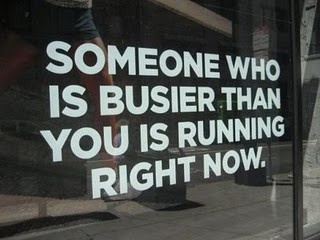
Someone who is busier than you is running right now.

“Someone who is busier than you is running right now.” Ain’t it the truth! Today is my first day out in the so-called “real world” as a working adult. I am fortunate enough to have landed a full-time job right after college graduation in my field of study, doing exactly what I want to do. A lot of my peers were not as lucky, so in honor of them I refuse to let my new busy schedule get in the way of my running. Being busy is no excuse to stop, so I’m not going to let it. Happy running!

Maintaining a fitness schedule while working

On Monday, I start my very first “real-life” full-time job (yikes!) and besides the nervous first day jitters, all I can think about is how am I going to maintain my workout schedule while working 40 hours a week? I know this is not an impossible task by any means but it definitely will mean more determination, planning and a little extra will power to fight with that voice inside my head that’ll be saying “you’re tired.”

However, according to a great little article on one of my fav fitness blogs, the Greatist, planning ahead and literally marking gym time on your calendar is proven to help you stick to your fitness program. It said that marking gym time into your calendar like you would a meeting or a friend’s birthday will make your fitness time as important as these other cannot-miss appointments. So that’s what I did. I marked my gym time into my weekly calendar so I can’t make any excuse to skip. It also will hold me accountable for sticking to my plan.

The Greatist article also gives some other tips on how to stay true to your fitness program, some of which are extremely important to keep in mind.

  • Break it up- Working full-time and trying to maintain your health can be challenging sometimes. However, by breaking up your gym time, you might be able to fit in more exercise in your day. For example, if your goal for the day is to run 5 miles, try doing a short 2 mile run in the morning and a 3 mile run when you get home from work.
  • Be realistic- Don’t kill yourself trying to fit everything into your day. Despite my earlier post about morning workouts, if you’re not a morning person the habit won’t stick. Find the best time to fit in your exercise whether that be in the morning, during your lunch hour or after you get home from work. Picking a realistic time will help you to stick to the routine.
  • Add variety- Everyone gets sick of doing the same workout routine over and over and over again. Try switching it up. Swap a run for a cardio exercise class, or trade in lifting for crossfit. It’s a good idea to change your workout routine every now and then to avoid having your muscles get too used to the same routine.
  • Stay flexible- Sometimes, no matter how good you planned out your fitness schedule for the week, unanticipated events can pop up and set your plans awry. Don’t beat yourself up if you can’t make it to the gym or squeeze in a run when you planned to. It’s life and things happen. Try making up for it the next day with some extra gym time. It could help you de-stress!
  • Have fun!